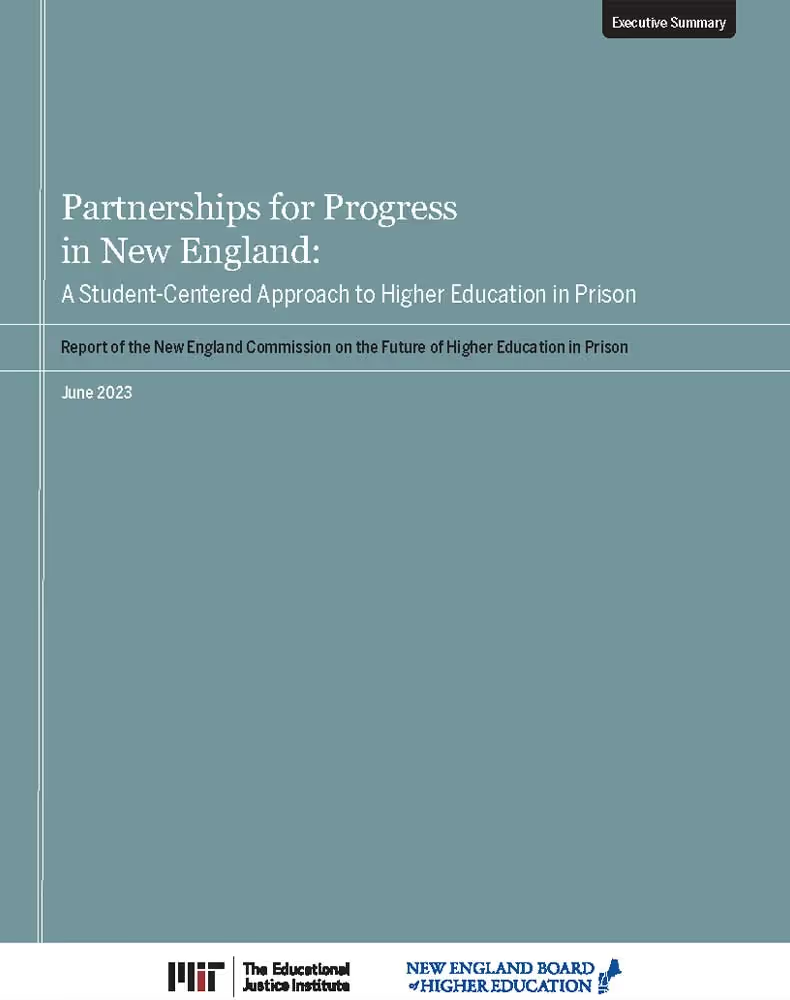
The New England Prison Education Collaborative (NEPEC) is a regional initiative led by the New England Board of Higher Education (NEBHE). In February 2024, NEBHE was awarded five years of grant funding from Ascendium Education Group to establish the Collaborative to build upon the recommendations of the 2023 New England Commission on the Future of Higher Education in Prison, a nine-month regional convening of leaders from across multiple sectors aimed at preparing the region for the reinstatement of federal Pell Grants for all currently incarcerated learners.
Through this initiative, NEBHE seeks to accelerate, support, and collaborate to help create a future where every incarcerated person in New England has access to high-quality, workforce-aligned, equitable postsecondary opportunities with a diverse range of educational pathways.
Select a tab below to learn more.
Members of the Regional Advisory Council provide strategic guidance and feedback to support the growth and continuous improvement of the New England Prison Education Collaborative (NEPEC) as we expand our work. These experts represent the six New England states and national efforts.
Beginning in 2025, the New England Prison Education Collaborative (NEPEC) will support all six New England states in the development of state strategic plans that aim to expand the quality and quantity of higher education in prison programming in their states.
Every quarter, the NEPEC team hosts a virtual workshop, which leverages insights from experts both in the region and beyond to address some of the most salient topics in higher education in prison. While open to the public, these quarterly workshops are structured so that they are particularly relevant to state stakeholders engaged in NEPEC’s state strategic planning initiative, which runs in year-long cycles. This aligns with one of NEPEC’s overarching goals: to support all New England states in developing state strategic plans aimed at expanding the quality and quantity of prison education program portfolios—and, if desired, pathways to vocational education—over the next five years. In this way, these events serve as capacity-building sessions for states in the region: both those who are currently undergoing our state strategic planning process and those who plan to do so in the future.
To watch recordings of previous workshop sessions or see the post-event resource documents, please see the links below. To attend a future workshop, please follow us on LinkedIn and subscribe to our newsletter to stay updated on future topic choices and be notified once registration goes live.
March 19, 2025: Conducting a Higher Education in Prison Needs Analysis.
June 18, 2025: Building and Sustaining a Prison Education Program
Members of our Higher Education Working Group provide direct subject matter expertise to shape a number of the deliverables under the higher education initiatives work stream.
Abraham Santiago
Policy Researcher
UConn IMRP
Bryan O'Connor
Director, Corrections Education
Community College of Vermont
Daniel McGloin
Director of Prison Education Partnership
University of Maine at Augusta
Gena Bianco
Dean
Roger Williams University EXT
Judy Castonguay
Adjunct Faculty
Community College of Vermont
Lauren Miller
Senior Manager
Jobs for the Future (JFF)
Leah Maciejewski
Vice President of Academic Affairs
White Mountains Community College
Mary Haynes
Manager of Continuing Education
Massachusetts Department of Correction
Omar Reyes
Director of Adult Programs & Student Success
Rhode Island Office of the Postsecondary Commissioner
Sheila Meiman
Prison Education Specialist
National Association of Student Financial Aid Administrators
Zelda Roland
Founding Director
Yale Prison Education Initiative
***** CURRENTLY CLOSED FOR 2025 *****
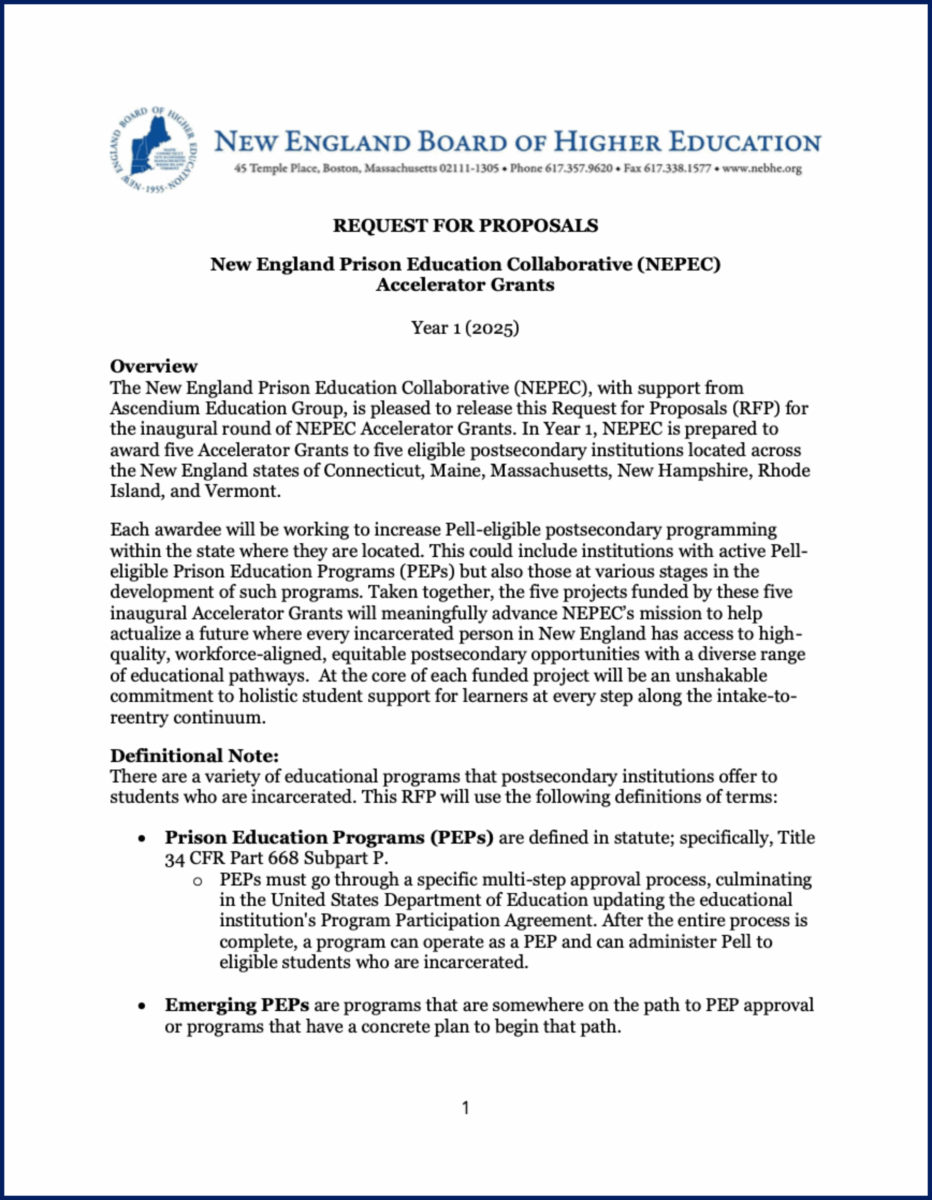
The application period for Year 1 of our Acclerator Grants closed on Friday, June 6, 2025 at 5 PM EDT, so we are not accepting more grant applications at this time.
Five Accelerator Grants will be awarded to eligible higher education institutions located across the New England states of Connecticut, Maine, Massachusetts, New Hampshire, Rhode Island, and Vermont to increase Pell-eligible prison education programming in their state.
Grant recipients will develop or expand programs, build partnerships, increase access to Pell funding, and support reentry efforts for students transitioning back to campus and home. Applicants are asked to submit proposals for $100,000 of funding for use over 12 months. Grant applications were due on Friday, June 6, 2025 at 5 P.M. EDT. Click here to view and download the Request for Proposals for the Accelerator Grants.
 Click here to view and download the list of questions on the RFP form.
Please note that this document is for informational purposes only. Only a completed Microsoft Form will satisfy that portion of the application requirements.
In collaboration with subject matter experts, NEPEC will facilitate states’ progress toward increasing public availability data about higher education in prison –both related to student access and student success.
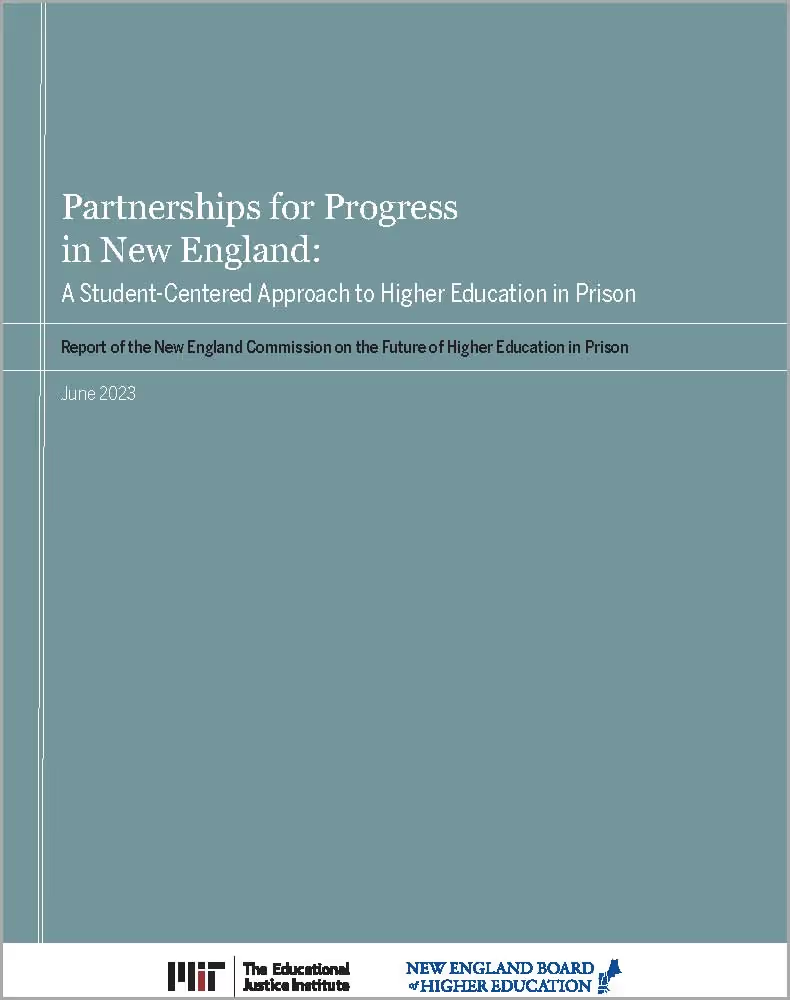
The Commission was an interstate collaboration composed of New England’s foremost leaders in higher education, corrections, legislation, business, and policy. Members shared a commitment to expanding high-quality, workforce-aligned postsecondary prison education programming to improve lives, meet the region’s workforce needs and improve the re-entry process for system-involved people.
The New England Commission on the Future of Higher Education in Prison (“the Commission”) was a key initiative of the New England Board of Higher Education (NEBHE) and The Educational Justice Institute at MIT (TEJI) chaired by Lee Perlman and Michael K. Thomas. While the Commission’s origins were regional, it sought to catalyze a national initiative and assume a broader leadership role in the United States.
The Commission’s 83 members worked to develop 15 recommendations to align institutions, policymakers, prisons, and industry to increase the academic, socioemotional and career readiness of system-involved people—and facilitate their successful transitions to work and sustained contributions to the well-being of the region and nation. 20% of the Commission’s membership were comprised of system-involved leaders and advocates.
On June 7, 2023, the Commission delivered its final report with recommendations for higher education leaders, policymakers, departments of correction and employers ahead of the July 2023 reinstatement of Pell Grants for eligible incarcerated students.
Select a tab below to learn more.
Click here to access the member-created “Regional MOU Template.” *
*Note: Members or affiliated organizations do not claim that the information contained in this document guarantees compliance with state or federal rules addressing prison education programming. Regulatory language and references are subject to change. The information should not be considered legal advice and legal questions should be directed to legal counsel.

Director, New England Prison Education Collaborative and Transfer Initiatives
Sarah Kuczynski is the Director of the New England Prison Education Collaborative (NEPEC) and Transfer Initiatives at the New England Board of Higher Education (NEBHE). In this role, Sarah is leading the roll-out of NEBHE’s new five-year, Ascendium-funded project to expand access to higher education in prison across the six New England states (Connecticut, Maine, Massachusetts, New Hampshire, Rhode Island, and Vermont). Beyond this, Sarah facilitates the New England Transfer Guarantee--NEBHE’s state-specific community college transfer initiative which is now fully operationalized in all six states in the region.
Sarah was the primary author of the June 2023 report of the New England Commission on the Future of Higher Education in Prison.
Prior to joining NEBHE, Sarah worked in student success at the collegiate and high school level. Born and raised in New Orleans, Louisiana, Sarah holds a B.A. in English from The George Washington University, a PhD in English from UNC-Chapel Hill, and an EdM in Education Policy and Analysis from Harvard Graduate School of Education.

Project Manager, New England Prison Education Collaborative
Zeia serves as a Project Manager for the New England Prison Education Collaborative (NEPEC), a grant-funded initiative of the New England Board of Higher Education (NEBHE). In this role, she leverages skills in program development, stakeholder engagement, and data-informed decision-making to co-manage NEPEC’s rollout across the six New England states.
Zeia’s career reflects her passion for social justice. Before joining NEBHE, she served as an Equity and Learning Specialist at Planned Parenthood League of Massachusetts, where she developed and facilitated diversity, equity, and inclusion trainings and actively supported organizational race equity initiatives.
Previously, as a research intern at Massachusetts Appleseed Center for Law and Justice, Zeia contributed significantly to influential reports on systemic inequities in school discipline and barriers to legal access in Massachusetts.
Zeia earned her B.A. in International Studies from American University, focusing on Justice, Ethics, and Human Rights. She is enrolled in an M.S. in Data Analytics and Computational Social Science at the University of Massachusetts, Amherst, further strengthening her ability to leverage data for meaningful social impact.
.avif)
Project Coordinator, New England Prison Education Collaborative
Quinn Barton serves as a Project Coordinator for the New England Prison Education Collaborative (NEPEC), a grant-funded initiative of the New England Board of Higher Education (NEBHE). In this role, Quinn leads the team's social media strategy and content, coordinates internal and external communications, and provides administrative support.
Quinn’s career is driven by her passion for facilitating actionable change in society through communications campaigns and policy research. Her pivot towards educational reform in prison on the New England Prison Education Collaborative reflects her commitment towards uplifting marginalized members of society.
A graduate of Boston University, Quinn holds a B.S. in Media Science with minors in International Relations and Political Science with a focus on the intersection between the public sector and political discourse.
.avif)
Stakeholder Engagement Specialist, New England Prison Education Collaborative
Nurudeen Alabi serves as a Stakeholder Engagement Specialist for the New England Prison Education Collaborative (NEPEC), a grant-funded initiative of the New England Board of Higher Education focused on expanding access to higher education in correctional settings across the six New England states. In this role, he works to strengthen partnerships among higher education institutions, correctional agencies, community organizations, and directly impacted individuals to support equitable and sustainable prison education initiatives.
Nurudeen draws from his lived experience with incarceration and his educational journey, being the first student of the Boston College Prison Education Program (BCPEP) to graduate on campus and earn his B.A in Business Marketing. He brings a deeply informed perspective to advocacy, public speaking, and systems change work centered on second chances and educational opportunity. His work focuses on stakeholder engagement, strategic collaboration, and elevating the voices of formerly incarcerated individuals in policy and practice discussions.
Nurudeen is passionate about using education as a pathway to personal transformation, civic engagement, and long-term community impact.